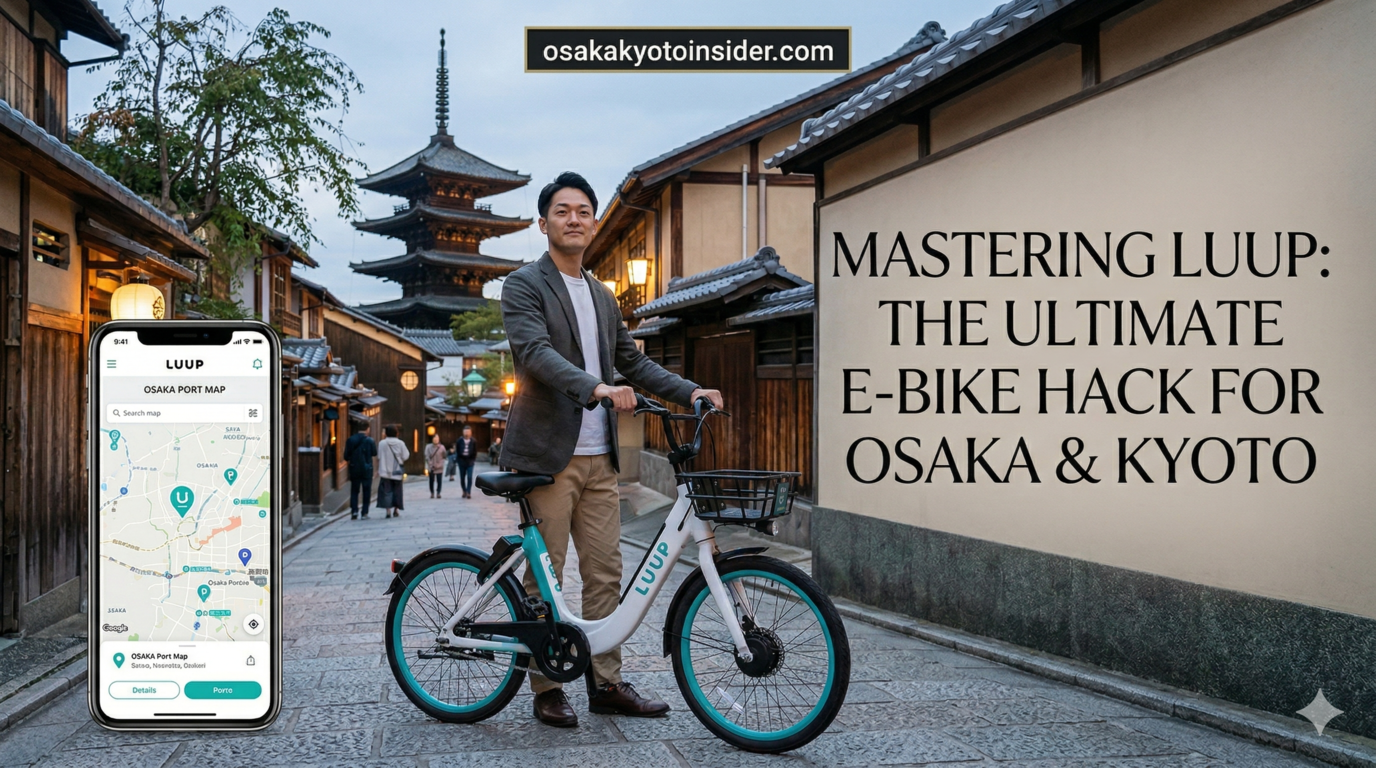
Listen, I love the Japanese public transit system as much as the next person. The trains run exactly on time, and the subway networks in Kansai can get you almost anywhere. But if you want to experience Osaka and Kyoto like a true local, spending your entire trip underground or crammed into a sweaty, overcrowded bus is not the way to do it.
Enter LUUP.
If you’ve walked around Osaka or Kyoto for more than five minutes, you’ve probably noticed those sleek, turquoise-and-white electric bicycles and kick scooters parked outside convenience stores, apartment buildings, and cafes. That’s LUUP, Japan’s dominant micro-mobility sharing service.
For tourists, this app is an absolute game-changer. It allows you to bypass Kyoto’s notorious bus traffic and effortlessly glide between Osaka’s sprawling neighborhoods. But there’s a catch—if you wait until you’re lost in the city to download it, you’re going to have a bad time.
Here is everything you need to know about using LUUP in Osaka and Kyoto, plus a few local secrets to keep you riding smoothly.
The Golden Rule: Set Up the App BEFORE You Need It
Here is my biggest insider tip for using LUUP: Download the app and complete the setup process while you are still in your hotel room—or better yet, before you even board your flight to Japan.
Do not wait until you are standing outside a FamilyMart in Dotonbori with a 2% phone battery and spotty pocket Wi-Fi. The registration process is straightforward, but it takes a few minutes and requires a bit of focus.
To legally ride a LUUP e-bike or e-scooter in Japan, the app requires you to:
- Register a valid credit card.
- Verify your age by scanning a valid ID (for inbound tourists, this means your passport).
- Pass a mandatory Japanese traffic rules quiz.
Don't panic! The quiz is fully available in English, and the app provides a handy study guide right before you take it. It’s mostly common sense (e.g., don't drink and ride, ride on the left side of the road), but you must get every single question right to pass. If you fail, you can instantly retake it, but you really want to do this from the comfort of your hotel bed rather than on a bustling street corner.
How Much Does It Cost?
LUUP is incredibly affordable and often cheaper than taking a taxi for short distances. In both Osaka and Kyoto, the standard pricing structure is:
- Base Unlock Fee: 50 JPY
- Time Fee: 15 JPY per minute
So, a quick 10-minute ride from Namba to Shinsaibashi will cost you exactly 200 JPY. A leisurely 20-minute cruise along the Kamo River in Kyoto will run you 350 JPY. The app automatically charges the credit card you have on file the second you lock the bike and end your ride.
How to Ride Like a Pro
Using the app is incredibly intuitive, but it operates a bit differently than scooter apps you might have used in the US or Europe like Lime or Bird.
1. Reserve Your Destination Port First
You cannot just abandon a LUUP bike on a random sidewalk. You must return it to a designated LUUP port. When you scan a bike's QR code to unlock it, the app will force you to select your destination port before the bike unlocks. This is actually a brilliant feature because it guarantees you will have an empty parking spot waiting for you when you arrive. (Don't worry, if you change your mind mid-ride, you can easily change your destination port in the app).
2. Take the Checkout Photo
When you arrive at your destination, push the bike into the designated green rectangle on the ground, lock the back wheel manually, and hit "End Ride" in the app. The app will then ask you to take a photo of the parked bike to prove you left it neatly inside the lines.
3. E-Bikes > E-Scooters
The LUUP app lets you rent both kick-scooters and pedelec e-bikes. Insider Tip: Always opt for the e-bikes. The kick-scooters might look fun, but Osaka’s sidewalks are notorious for slightly uneven curbs, and navigating them on tiny scooter wheels can be jarring. Plus, Kyoto has some sneaky, long inclines (especially heading east towards Kiyomizu-dera). The e-bikes have plush seats, powerful electric pedal-assist, and most importantly, a front basket to hold your backpack or your massive Don Quijote shopping haul.
Local Traffic Rules You Must Know
Japan takes bicycle rules seriously, and as a tourist, you are not exempt.
- Keep Left: Japan drives on the left, and bikes ride on the left.
- Sidewalk Rules: You can ride on the sidewalk if the road is too dangerous, but pedestrians always have the right of way. Keep your speed low.
- The Kyoto Sidewalk Ban: Kyoto has strict rules against riding bicycles on the sidewalks of major shopping streets during the day. Specifically, Shijo-dori and Kawaramachi-dori ban bicycles on the sidewalks between 8:00 AM and 9:00 PM. Do not ride here; instead, take a parallel side street like Tominokoji-dori or Gokomachi-dori. It’s much more scenic anyway!
- No Riding in Arcades: In Osaka, do not try to ride your LUUP through the covered Shinsaibashi-suji shopping arcade. It is heavily crowded and strictly prohibited. If you need to cross through, you must dismount and push the bike.
Two Perfect LUUP Routes to Try
Ready to ride? Here are two of my absolute favorite routes that are vastly superior on a LUUP than on public transit.
Osaka: The Midosuji to Nakazaki-cho Cafe Run
Osaka’s main north-south artery is Midosuji Avenue, and it features a beautiful, dedicated bicycle lane on the far left side. Pick up a LUUP near Namba Station, and ride straight north up Midosuji. You'll pass under the gorgeous Gingko trees, safely separated from the car traffic.
Keep heading north past Umeda until you reach the retro, bohemian neighborhood of Nakazaki-cho. Park your bike at the LUUP port right outside Osaka Metro Nakazaki-cho Station Exit 1. From there, you can walk through the narrow, pre-war alleys and grab an incredible cup of pour-over coffee at Salon de AManTo, a cafe built into a 120-year-old traditional house.
Kyoto: The Kamogawa River Cruise
Kyoto bus #206 is notorious among locals for being packed shoulder-to-shoulder with tourists heading from Kyoto Station to Gion. Skip it entirely.
Instead, grab a LUUP bike from one of the massive ports near Kyoto Station (there is usually a fully stocked port right outside the APA Hotel Kyoto Station Horikawa-Dori). Ride a few blocks north until you hit the Kamo River (Kamogawa). There is a wide, paved, car-free path running right alongside the water.
You can cruise north along the river for miles, totally bypassing the city traffic, with the wind in your hair and the mountains in the distance. Take it all the way up to the Demachiyanagi area. Park your bike at the nearby Keihan Station port, and get in line at Demachi Futaba for their legendary mame-daifuku (mochi stuffed with red bean and salted peas) for about 220 JPY. Take your mochi back to the riverbank to eat—just watch the skies, as the local hawks are known to swoop down and steal food right out of your hands!